
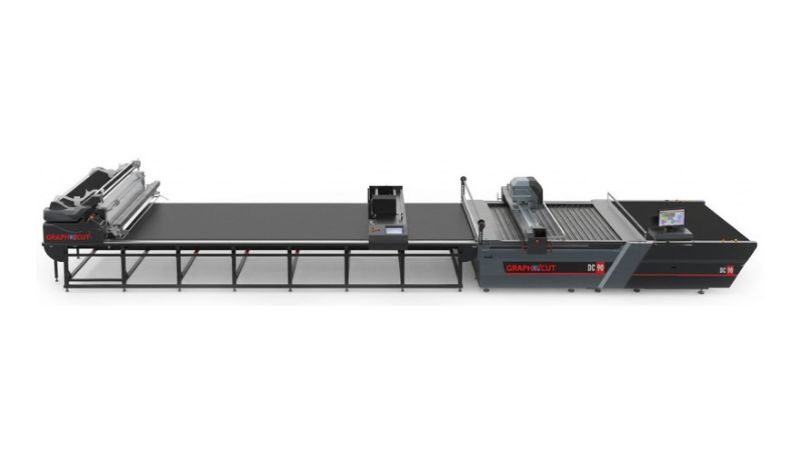
CNC fabric-cutting machines automatically cut textiles using computer-controlled tools guided by CAD/CAM software. They are transforming modern textile manufacturing by replacing slow, inconsistent manual cutting with fast, repeatable, high-precision production, reducing material waste, shortening lead times, and lowering costs. Below, we explain how the technology works, which industries benefit most, and how to choose the right system.
What Is a CNC Fabric Cutting Machine and How Does It Work?
A CNC (Computer Numerical Control) fabric-cutting machine is an automated system that cuts textiles and technical materials to a precise digital pattern without human guidance. Instead of following a chalked or printed outline, the machine reads a digital file and drives a cutting tool along the exact path.
The workflow is simple once you break it down:
- Design: create or import a pattern into CAD software as a digital file.
- Nesting: marker-making software arranges the pattern pieces to fit the fabric with the smallest possible gaps.
- Spreading: the fabric is laid out, either as a single ply or in multiple layers.
- Cutting: the CNC head follows the digital path and automatically cuts each piece.
This CAD/CAM integration is the heart of the technology. CAD (computer-aided design) creates the pattern; CAM (computer-aided manufacturing) sends the cutting file to the machine. Because the same digital software drives both design and cutting, there is no manual re-drawing and far less room for error.
Our own CNC automated fabric cutters use different tool types depending on the material: drag knives, oscillating blades, and rotary tools, so a single machine can handle everything from delicate silk to dense stacks of technical fabric. The result is a fully automated fabric cutting system rather than a series of one-off manual cuts, and it forms the backbone of a modern digital cutting room.
Why Traditional Fabric Cutting Methods Are No Longer Enough
Manual cutting served the textile industry for decades, but it carries limitations that become expensive at scale. As order volumes rise and lead times shrink, hand cutting struggles to meet quality and cost expectations.
The recurring problems with traditional cutting methods include:
- Inconsistent cuts: Two operators, or the same operator on different days, rarely produce identical results. Small variations in each cut piece add up across a production run.
- Labour dependency: Skilled cutting is a specialist trade, and output is directly tied to the number of trained hands available.
- Slower production: Cutting one ply at a time by hand cannot match the throughput of an automatic cutting machine that works through single or multiple layers at once.
- Material wastage: A skilled hand cutter can achieve near-zero gaps between pieces, so the real losses come from manual marker planning nesting less efficiently than CAD auto-marker software, and fabric is the most valuable input in most textile products.
That last point matters most financially. Industry research estimates that cut-and-sew waste typically ranges from 10% to 15% of fabric during garment manufacturing, and it can rise further for complex styles. When fabric is your biggest cost line, every percentage point recovered goes straight to the bottom line.
Even low-volume, bespoke, and sampling work benefits from CNC, with compact single-ply and studio sample cutters built specifically for this kind of production. And for consistent, repeatable, high-quality output at volume, most manufacturers reach the limits of manual methods sooner than they expect.
Key Benefits of Using an Automatic Fabric Cutting Machine
Moving from manual cutting to digital fabric cutting technology delivers measurable gains across the production line. The main benefits are consistent and well documented.
- Higher accuracy: The machine cuts to the digital pattern every time, producing high-precision, repeatable pieces that fit correctly at the sewing stage.
- Reduced fabric waste: Tighter nesting and precise cuts recover material that manual methods lose. Our solutions help manufacturers reduce material waste by up to 25%, protecting both margins and sustainability targets.
- Faster production cycles: Automated cutting runs continuously and can process multiple layers in a single pass, dramatically increasing throughput for large-scale manufacturing.
- Consistent quality: Every cut piece matches the previous one, reducing rework, improving fit, and raising overall product quality.
- Lower operating costs: Less waste, less rework, and reduced reliance on hard-to-find manual cutting skills combine into significant, ongoing cost savings.
The waste reduction and quality gains reinforce each other. Our nesting and marker-making software squeezes more pieces from every metre of fabric, while automated fabric spreaders lay material flat and tension-free so the spread is accurate from the first ply to the last.
Industries That Benefit Most from CNC Textile Cutting Machines
CNC textile cutting machines are not limited to one sector. Any business that cuts soft material to a repeatable pattern can benefit, and the technology now spans industries with very different requirements.
- Fashion and apparel manufacturing: From high-street volume to bridal couture, automated cutting improves fit, speeds up sampling, and cuts fabric costs across every collection. See our work in fashion and apparel.
- Technical textiles: Performance and protective fabrics demand exact tolerances that manual cutting cannot reliably deliver.
- Automotive interiors: Seat covers, trim, and airbag materials require precise cuts with high-volume consistency.
- Aerospace materials: Composite plies and reinforcement fabrics must be cut to tight specifications with full traceability.
- Furniture and upholstery: Complex shapes and pattern matching are handled cleanly and repeatably. Explore our furniture and upholstery solutions.
- Leather goods and footwear: From automotive and furniture to fashion and footwear, automated cutting works around irregular hide shapes and surface defects that slow a manual operator considerably. See our CNC-automated leather cutting.
The material range is just as broad. Our cutting systems handle high-performance fabrics such as Kevlar and carbon fibre, natural and luxury materials including leather, silk, and cashmere, and everything in between. For hides and skins specifically, CNC-automated leather cutting handles irregular shapes and surface defects that would slow a manual operator considerably.
This versatility is why our technology is trusted across defence, aerospace, medical, and personal protection sectors, where precision and repeatability are not optional. You can see the full breadth of applications on our other industries page.
How CAD/CAM Technology Improves Fabric Cutting Accuracy
A CNC fabric cutter is only as good as the software driving it. CAD/CAM technology turns a fast machine into an accurate, efficient production system and removes the manual steps where errors often creep in.
Accuracy improves at three key stages:
- Digital pattern creation: Patterns are drawn and graded digitally, so sizing is mathematically consistent rather than manually redrawn. Our pattern-cutting and grading software makes pattern creation and grading quick and precise.
- Intelligent nesting: Marker-making software automatically calculates the most efficient layout, packing pattern pieces tightly to maximise fabric yield before a single cut.
- Automated cutting: The finished marker is sent straight to the machine, which cuts exactly what the software planned: no transcription, no re-marking, no drift.
Our 2D software is designed for fashion, apparel, furniture, and upholstery, and is compatible with commercially available body-scanning systems for made-to-measure and bespoke work. Design files support DXF format and export to Adobe Illustrator, so patterns move cleanly between systems without being redrawn.
For converting existing paper patterns into digital files, our photo digitising systems capture a physical pattern in seconds, while our design studio hardware prints and plots at full production scale. Together, these tools close the loop between the design room and the cutting floor.
How to Choose the Right CNC Fabric Cutting Machine for Your Business
No single “best” machine exists; the right choice depends on what you cut, how much you cut, and how your production is structured. We recommend weighing the following factors before you invest.
- Material types: The fabric or substrate you cut determines the tooling. Silks, thick leather, coated technical fabrics, and rigid composites each call for different blades and vacuum settings.
- Production volume: Low-volume sampling and bespoke work suit a single-ply CNC fabric cutter or a studio CNC sample cutter, while high-volume production is far more efficient with a multi-ply CNC fabric cutter that cuts many layers at once.
- Cutting speed: Balance precision and speed against your throughput targets; the fastest machine is not always the right one if your work demands fine detail.
- Accuracy: Match the machine’s tolerances to your product. Aerospace composites and protective equipment demand tighter accuracy than general upholstery.
- Software compatibility: A cutter is only useful if it integrates with your design and nesting tools. All of our cutting machines integrate seamlessly with our CAD/CAM software, and DXF, HPGL and CUT file support keeps the door open to other systems.
- Maintenance and support: A cutting machine is a long-term investment, so factor in training, servicing, and response times for when a fault stops production.
That last point is where many buyers under-plan. A capable machine still needs a capable partner behind it. Our nationwide technical support and training team provides virtual and on-site assistance, along with the training that helps your team get full value from the equipment from day one.
The Future of Textile Manufacturing Is Automated Cutting
Automated cutting is no longer a competitive advantage held by a few large manufacturers; it is becoming the baseline for anyone competing on cost, speed, and quality. The direction of travel is clearly toward more connected, more automated production.
Industry 4.0 is reshaping how cutting rooms operate. In a connected factory, design, nesting, spreading, and cutting share the same digital data, so information flows from the first sketch to the final cut without manual re-entry. This reduces errors, improves traceability, and shortens time to market.
The advantages compound over time:
- Data-driven efficiency: Every job produces data on yield, speed, and utilisation that can improve the next one.
- Reduced reliance on scarce skills: As experienced manual cutters retire, automation preserves capacity and quality.
- Sustainability: Cutting waste means using less fabric and energy per unit, increasingly a commercial requirement as well as an ethical one.
For manufacturers planning ahead, investing in a scalable digital cutting machine today lays the groundwork for a fully connected cutting room tomorrow. Businesses adopting these industrial fabric-cutting solutions now are best positioned for the next decade of textile manufacturing.
What Matters Most When Automating Your Cutting Room
- A CNC fabric cutting machine uses CAD/CAM-driven, computer-controlled tools to cut textiles automatically with high precision and repeatability.
- Manual methods struggle with inconsistency, labour dependency, slow throughput, and material waste, typically 10–15% of fabric on cut-and-sew work.
- The core benefits are higher accuracy, less waste, faster production, consistent quality, and lower operating costs.
- The technology suits fashion, technical textiles, automotive, aerospace, furniture, and leather, cutting materials from silk and cashmere to Kevlar and carbon fibre.
- Choose a machine based on material, volume, speed, accuracy, software compatibility, and, critically, the support behind it.
- Automation and Industry 4.0 are becoming the standard, not the exception, for competitive textile manufacturing.
Ready to Modernise Your Cutting Room? Talk to Our Team
In an industry where precision and speed define success, the technology behind your design room matters more than ever. At VetiGraph, we have been powering fashion and textile manufacturers with cutting-edge CAD/CAM software, CNC fabric cutters, and PLM solutions for over 35 years, trusted by design studios, global brands, and production teams right across the UK. From first cut to final product, our expert team is with you every step of the way. Ready to work smarter? Call 01273 672400 or get in touch.


